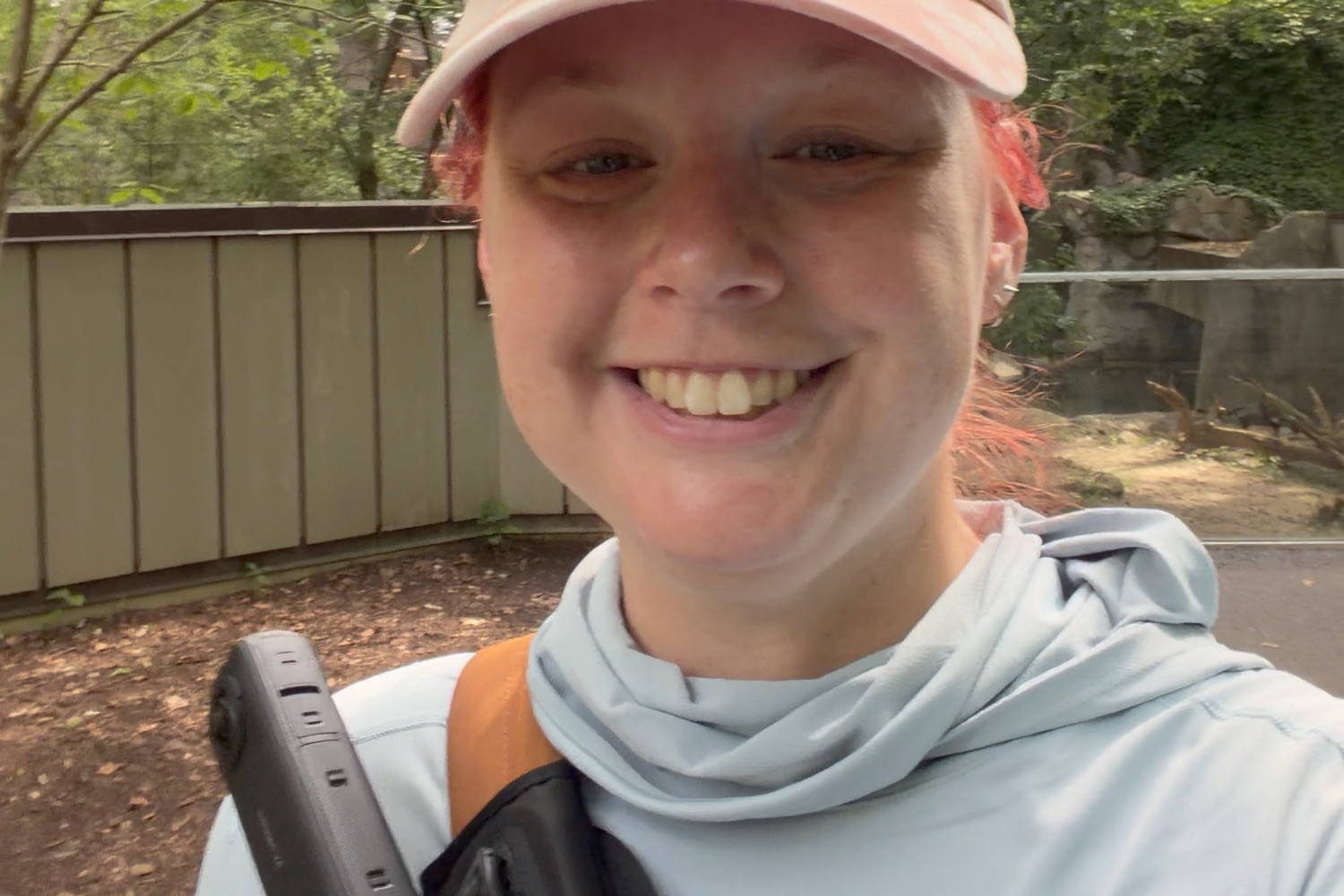
What I film is me out doing things - desert hikes, off-roading, walking through a city, wandering around a museum. Not places so much as being in them. Which means most of the time I'm the subject and the crew at once, and that turns out to be the whole problem worth solving. Nothing on this page is an affiliate link - I don't earn anything from any of it.
The tripod I don't set up
There's a version of this where I stop partway up the trail, set up the phone tripod, walk back down, walk toward the camera doing the thing I was already doing, then walk back again to collect it. Four trips for one shot of me hiking.
I haven't had it in me. Not once - every desert hike so far has been 360 footage or handheld phone, and I don't think that's going to change. So instead of pretending otherwise, the kit is built around it: I don't set up shots, so I need cameras that don't need shots set up. Everything below follows from that.
Running it non-stop
The Insta360 runs continuously. That's the whole trick - I'm not composing, not starting and stopping, just letting it capture the hike while I hike it, and choosing the framing later, sitting down, which is the only point at which I've ever actually wanted to make that decision.
It's what I use for hiking and for general capture that has to serve more than one thing at once - long-form YouTube, work, whatever else it turns into later. It's also what I reach for driving.
The extender pole is the part I'd underline for anyone deciding. The pole disappears in the stitch, so a shot taken off the end of it looks like it came from somewhere nobody was standing - above me, pulling back, following from overhead. Drone angles without a drone: nothing to launch, no airspace to think about, no permit, and it comes along on a hike a drone wouldn't.
Made this way Filming the drive instead of the destination Instagram 1,344 views TikTok 197 views
Smooth and close
The DJI gimbal is for walking footage - the shots that move with me and need to not look handheld. It's also what I use for a single-shot interior grab, where I want one clean continuous move through a space instead of a series of cuts.
Made this way The free upgrade at Mandalay Bay Instagram 2,242 views TikTok 1,239 views
The one I actually reach for
For all of that, the iPhone 17 Pro is still my go-to. Most short form starts on the phone, and anything where I'm talking to camera is the phone.
The tripod's job is here, not on the trail. It's for the static shot - camera stays put, I stay in front of it. It collapses down small and packs easily, which is why it still comes on hikes where I never take it out of the bag.
Made this way $25 to bake on the salt flats Instagram 29K views TikTok 3,122 views The place, in Findings
Sound
The DJI mics are the thing on this list I'd recommend hardest. Audio is what nobody notices until it's wrong - people don't finish a video thinking about how good it sounded, but bad sound closes the tab.
Wind is what made me buy them, and not for the obvious reason. It isn't that wind noise sounds bad - it's that a phone fighting wind muffles everything down along with it. You lose the gravel underfoot, the birds, whatever that place actually sounded like, and what's left is a flat dull roar. The mics mean I get to keep the ambient sound when I want it, which out here is most of the time.
One capture, two cuts
One walk, one continuous take, two destinations - and they don't get treated the same.
Short form gets cut in Edits, with trending audio. That's deliberate rather than lazy: on Instagram, TikTok and Shorts the sound is part of how a post gets found at all, and the platform carries the licensing for using it. The trending track is closer to distribution than decoration.
Long form goes through DaVinci Resolve - but not straight away. The 360 footage has to be converted to mp4 in the Insta360 app before Resolve will touch it. Running the camera non-stop costs nothing on the trail and gets paid for at the desk.
For long form the audio comes out of the Insta360 library instead, so there's nothing to worry about on copyright. On YouTube a popular track buys you no discovery, and a claim just means the video earns for somebody else or goes dark in some countries. Same footage, opposite right answer, depending on where it's going.
Made this way You can drive on the salt flats for free Instagram 3,343 views TikTok 43.3K views The place, in Findings
All of it is ours
Every frame on the channel was shot by me or my partner. No stock, no borrowed clips. If you want to see what the kit above actually produces, it's on YouTube.
Next · Part 5Three zones at onceWorking one time zone and living in another.Read part 5 →