What I use

The gear, apps, and accounts I actually use out here. Almost all of it is a plain recommendation with nothing in it for me — the one exception is flagged where it appears.

What I use

The setup behind the life

People ask how we actually pull this off — where we sleep, what we drive, what's in the truck. This is the honest answer: the things I'd tell a friend about, not a sponsor reel. Every link here is a plain recommendation except one, and I've said so right where it is. Tap either box to open it.

Where we stay House-sits, points, and one honest rule about Airbnb

Airbnbs try to be a home. They're just empty houses with no warmth or care. We look for private places to stay, not shared spaces — and we looked hard at Airbnb, but for the places we need to be, the pricing rarely makes sense, and there's that clinical feel on top of it.

The axis that actually matters is lived-in versus transient. A house-sit is warm because someone actually lives there. A hotel is fine because it never pretended to be a home — the transience isn't out of place. Airbnb fails because it's stuck between the two: it performs homeyness without the life behind it.

So it's a hierarchy, not a list:

  1. TrustedHousesitters — the default. Free lodging in exchange for pet care. It's how we live.
  2. Hilton Honors — the seam. Rare. A night between sits, or the buffer night when we fly to one.
  3. MGM Rewards — the deliberate break. In or near Vegas, when we want a break between sits.

TrustedHousesitters

How it actually works

This is how we find 99% of our sits, and how we live rent-free while we do it: you look after someone's home and pets, they get peace of mind, and you get a place to land. Twenty-five sits in, with this August marking a year of doing it — about a sit every two weeks. Five homes have already asked us back, with more return visits booked. That last number is the one I'd watch: it's the proof the whole system works.

The plans — sitter tiers, in USD:

PlanPriceBooking fee
Premium Sitter$259/yrnone
Standard Sitter$169/yr$12 per sit
Basic Sitter$129/yr$12 per sit

Prices checked 23 July 2026.

Basic gets you unlimited access to sits and a free background check. Standard adds the things that matter mid-search — vet video calls and chat, instant alerts on unlimited saved searches, member support, and an accident and third-party liability plan. Premium adds the booking-fee waiver, a sit cancellation plan, two global airport lounge passes, and a profile badge.

Which tier? Premium costs $90 more than Standard, and Standard charges $12 a sit — so Premium pays for itself at eight sits a year. We did twenty-five. That's the honest reason I'm on it, and the lounge passes only earn their keep because we occasionally fly to a sit. Either way, a year runs about the cost of one or two hotel nights.

What actually gets you invited back isn't the membership — it's everything around the sit. Every one of these does the same job: it takes a little more of the homeowner's anxiety off the table, at a different point in the process.

  1. Application. Be yourself, and be honest. I say I work from home and will be around all day when that's true. And I talk about the pets specifically — what it is about them that made me want the sit. Dogs that hike or walk are a green light; I want a movement buddy. I'm choosing the sit by the animal, not the house.
  2. Before an offer. We always offer to talk before anyone expects us to commit.
  3. Before it starts. We do our best to meet the owner in person — in the days leading up, or by showing up early before they leave — to get the lay of the land.
  4. During. On longer sits we offer video calls, so owners can see their pets while they're away and missing them. Low cost to us, real peace of mind for them.
  5. Departure and after. We leave the house as close to how we found it. On the way out I send a templated text with the status of everything: pet fed and walked, bathrooms, washer and dryer, dishwasher, where the mail and packages are. Afterward, when I see a listing from a home we've sat, I reach out even when we can't take it — a wish we could see the pet again, enjoy your trip note that keeps us in mind. And when we're heading back to an area, I message past owners nearby: we'll be around these dates, in case you want to grab lunch or have travel of your own coming up.

My referral link gets you 25% off an annual membership — and if you sign up, I get two months free. (Yep, it's a referral link — thanks for using it.)

Get 25% off TrustedHousesitters →

Once you're sitting regularly, the days start adding up in ways that matter — Schengen windows, US state-residency lines. That's exactly why I built Sojourn, a free tool to log your stays and watch those counts for you.
Hilton Honors

The seam-filler

A night between sits, or the buffer night when we fly to one — rarely more than two, usually a mix of points and cash. The buffer matters more than it sounds, on both ends: you can't cut a flight close to a sit's start, and you need a cushion on the back end too, in case the owner's return flight goes sideways.

MGM Rewards

The tier match

If you already hold status somewhere, don't leave it on the table. I matched into MGM Gold off Royal Caribbean status — you go to the rewards desk in person, show your cruise tier, and they bump you up. Gold gets discounted rates and comped rooms at the cheaper properties: Excalibur, New York-New York, Luxor.

The catch worth knowing before you lean on it: it has to be re-upped every year when the rewards card expires, and the renewal is in person — which gets tricky when you're not physically there and trying to book on those rates. The more you book, the better the rates get. This June it got us a week at Excalibur for under $200.

How we get there A stock Bronco Sport, onX, and what's always in the truck

Mostly, we drive. Flying is the exception, not the method — it lives up in "where we stay," as the buffer night. This is the part we actually chose: a stock SUV and a lot of backroads.

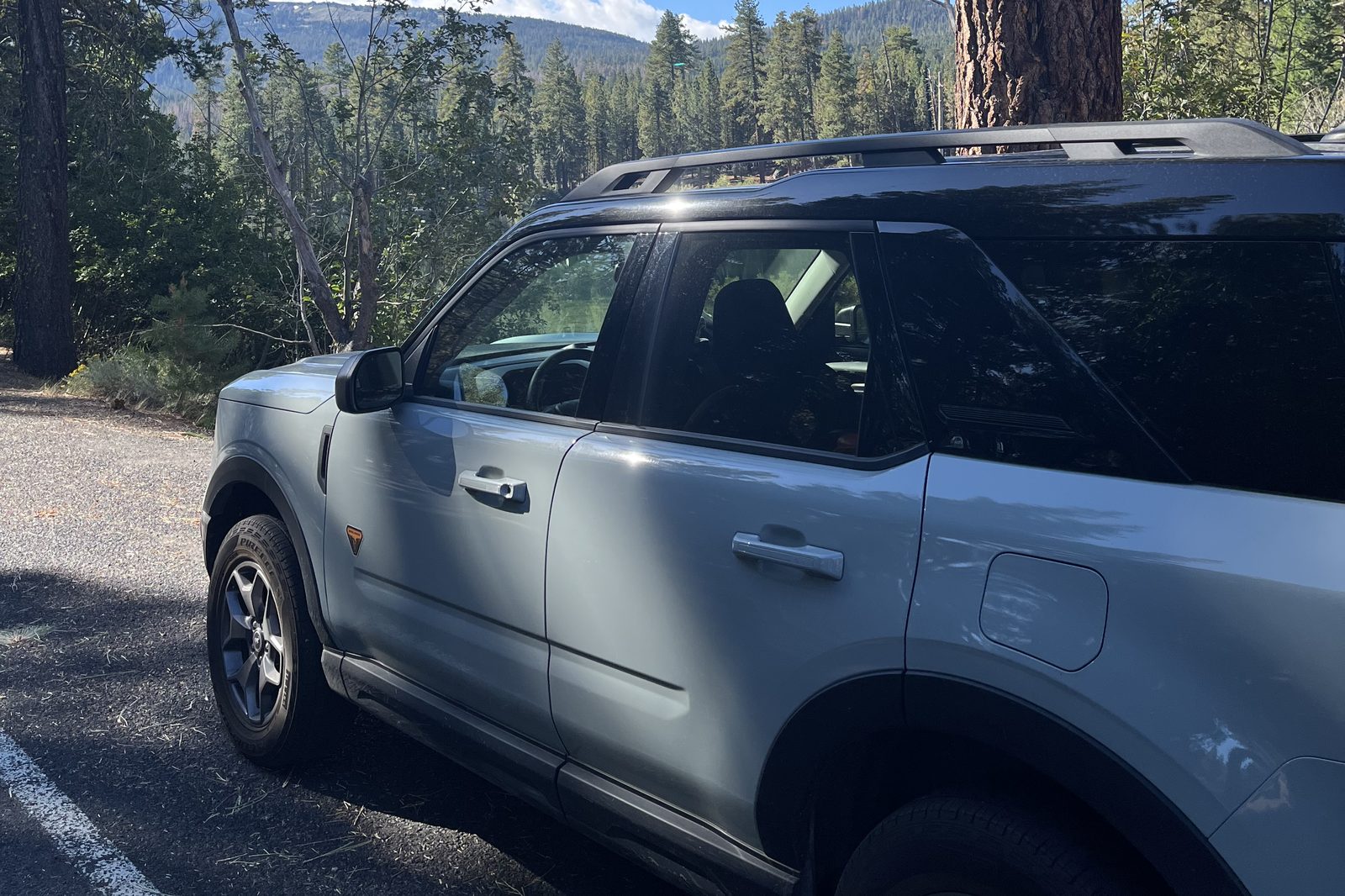
Daisy, a sage-green Ford Bronco Sport, parked among tall pines with a mountain valley view behind

Daisy — 2024 Ford Bronco Sport

Two years and 38,000-plus miles in, completely stock. Nothing changed — and that's the point; it makes the rest of this land harder. When we left Florida we sold our car, knowing we'd buy something once we landed in Vegas. Andrew wanted to get out in the desert and try overlanding, so we did a lot of research in our price range, a lot of test driving, and settled on Daisy.

The honest trade-off: the mileage is lower than Andrew would have liked. For what we like doing, it's worth it. If you're deciding between the Sport and the full Bronco, that's the real question — and for us the Sport, stock, has gone everywhere we've pointed it.

onX Offroad

Where we go, and how we get back

Our go-to before we head off-road. The trail reports and previews let us make an honest call for our skill level and plan where to go — or where to go back to. And we're still beginners: onX rates trails by color and we stick to greens. We've been eyeing a blue but haven't committed. We read the reports to be sure there's no rock crawling and that the ruts are actually passable at our clearance, which isn't always the case.

The feature I'd miss most is breadcrumbs. There's a road near Vegas we love — quiet, fun, with the main track looping back out to the highway. Toward the back of the loop we peel off a little further for a proper middle-of-nowhere, just-us stretch. Breadcrumbs are what make finding our way back to the official path easy.

onX Offroad →

What's always on board

Med kit, a gallon of water, a sand recovery board, a self-jumper, a spare tire and jack.

The one time it all mattered: I was out near Mt Charleston on my own and got a flat. I changed a tire for the first time — on a decline, in a curve — with Andrew talking me through it over FaceTime from out of town. I was glad to have the water, the sunscreen, the spare, and the jack. The hard part was never being out there; it was the terrain — changing a tire on a slope you didn't get to pick.

What we don't carry — yet

Just as useful to know what you can skip. We run one recovery board, not a pair — there's no room for two once everything else is packed. No tire deflator or compressor yet either: we air down by hand at the trailhead and air back up at a gas station after. On the wishlist: external mounts for the boards, water tanks, extra fuel tanks, and a deflator-and-compressor setup.

More coming as I write it up — filming on the road, and working from anywhere.